
The Impact of AI on Software Development: Benefits, Risks, and Strategic Adoption

The Impact of AI on Software Development: Benefits, Risks, and Strategic Adoption
By ARK Digital Studio
The world of software development is evolving faster than ever — driven by customer expectations, innovation cycles, and the need for smarter, more efficient workflows. Today, artificial intelligence (AI) is no longer just a futuristic buzzword. It is reshaping how applications are built, tested, deployed, and maintained, revolutionizing developer productivity, product quality, and business outcomes.
AI‑powered tools and platforms are transforming traditional software development lifecycles, enabling organizations to deliver smarter, faster, and more secure solutions. But understanding how AI drives value — and what challenges it introduces — is essential for successful adoption.
In this blog, we’ll explore the core benefits of AI in software development, real‑world use cases, the key metrics to measure impact, common risks and challenges, best‑practice strategies for adoption, and emerging future trends.
What Is AI‑Driven Software Development?
AI in software development refers to the use of machine learning, natural language processing, intelligent automation, and predictive analytics to assist or automate various stages of the software lifecycle — from coding and testing to planning, deployment, and monitoring. Unlike standard automation tools, AI systems learn from data and patterns to offer context‑aware suggestions, predictions, and optimizations.
Core Benefits of AI in Software Development
1. Faster Development Cycles & Reduced Time‑to‑Market
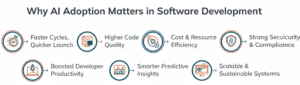
AI accelerates software delivery by generating code snippets, suggesting real‑time improvements, and auto‑completing repetitive tasks. Tools like GitHub Copilot and Tabnine help developers finish projects up to 40% faster, reducing bottlenecks and enabling quicker feature rollouts.
Key Impact:
- Shorter release cycles
- Increased agility to respond to market demands
- Competitive advantage
2. Improved Code Quality & Fewer Errors
Even experienced developers can overlook mistakes in large codebases. AI‑driven testing tools can analyze thousands of lines of code within seconds, detecting anomalies and vulnerabilities faster than manual review. Predictive bug detection helps flag issues before they occur, reducing downtime and defect leakage.
Key Impact:
- Higher code quality
- Fewer post‑release bugs
- Lower long‑term maintenance costs
3. Cost Efficiency & Resource Optimization
AI not only speeds up development but also reduces overall costs. By automating documentation, quality assurance, and routine QA testing, organizations save on manual labor while reallocating skilled developers to higher‑value work. AI‑driven project management tools can even predict delays or resource constraints before they occur.
Key Impact:
- Lower operational costs
- Better talent utilization
- More innovation focus
4. Smarter Decision‑Making with Predictive Analytics
AI models can analyze historical project data to forecast delivery timelines, highlight technical risk areas, and recommend strategic actions. This promotes proactive planning over reactive decisions and enhances resource allocation.
Key Impact:
- Fewer surprises during development
- Data‑driven decision frameworks
- Better risk mitigation
5. Enhanced Developer Productivity & Experience
AI tools reduce mundane tasks — like debugging, code formatting, or documentation — giving developers more time for creative problem‑solving and architectural design. New team members also onboard faster with AI guidance, while senior engineers focus on innovation.
Key Impact:
- Increased job satisfaction
- Reduced burnout
- Stronger collaboration
6. Stronger Security & Compliance
Continuous AI monitoring can identify security vulnerabilities and suspicious activity in real time. By learning from past threats, AI systems help maintain compliance with industry standards and protect sensitive systems.
Key Impact:
- Proactive security alerts
- Enhanced compliance posture
- Reduced risk of breaches
7. Scalable Systems & Sustainable Maintenance
As applications grow, technical debt and scalability become major concerns. AI can predict maintenance needs, recommend scaling decisions, and automate DevOps tasks — ensuring long‑term sustainability and smooth upgrades.
Key Impact:
- Fewer scalability bottlenecks
- Continuous integration
- Predictive maintenance
Real‑World Use Cases of AI in Software Development
AI is already driving transformation across multiple industries. Here are practical examples where its impact is most visible:
Healthcare
AI tools validate medical systems, simulate test scenarios, ensure compliance, and reduce bugs before deployment — critical for systems handling sensitive patient data.
Fintech
Predictive analytics and algorithmic risk detection help fintech applications flag fraudulent behavior in real time, streamline compliance reporting, and improve platform safety.
E‑Commerce
AI recommendation engines personalize shopping journeys, optimize search results, and drive higher engagement and conversions.
SaaS Platforms
AI monitors usage patterns, predicts system failures, powers smart support bots, automates updates, and improves uptime — freeing developers to focus on new features.
Gaming Industry
Developers use AI for adaptive experiences, accelerated testing, and intelligent NPC behavior — enhancing gameplay while speeding up delivery.
Metrics That Matter: Measuring the Impact of AI
To truly quantify the value of AI in software development, organizations should track metrics that reflect speed, quality, cost, productivity, security, and user satisfaction:
Development Speed & Delivery Cycles
- Cycle Time
- Lead Time for Changes
Code Quality & Defect Reduction
- Defect density
- Bug leakage rate
- Code review efficiency
Cost & Resource Metrics
- Development hours saved
- Operational cost reduction
- Team utilization rate
Productivity & Satisfaction
- Velocity
- Onboarding time
- Developer satisfaction scores
Security & Compliance
- Pre‑release security incidents detected
- Compliance pass rates
- Mean time to detect/respond
User Experience
- User engagement
- Churn rate
- Net Promoter Score (NPS)
(All above benefits and metrics are drawn from AI trends and analytical patterns in industry adoption.)
Challenges & Risks of AI in Software Development
While the benefits are significant, AI adoption also comes with challenges every organization must navigate:
Skills Gap & Learning Curve
AI tools require expertise in machine learning and data engineering — skills that many teams lack initially.
Data Quality and Bias
AI models are only as good as the data they learn from. Poor data quality or biased datasets can lead to unreliable or unfair outputs.
Integration with Legacy Systems
Older infrastructure may not support modern AI workflows, making integration costly or complex.
Over‑Reliance on Automation
Excessive dependence on AI without human review can introduce hidden errors or technical debt.
Costs of Adoption & Maintenance
Initial investments — including infrastructure, retraining, and ongoing updates — can be significant.
Security Risks
AI systems themselves can be targeted or manipulated if not properly protected and governed.
Best Practices & Strategies for Responsible AI Adoption
To maximize AI’s impact while avoiding pitfalls, organizations should follow proven strategies:
1 Start with Pilot Projects
Pilot small use cases — like automated testing or documentation — to build confidence before scaling AI tools broadly.
2 Invest in Upskilling and Collaboration
Ensure developers are trained in AI tools, machine learning basics, and model governance for long‑term success.
3 Maintain Human‑in‑the‑Loop Systems
AI should augment, not replace, human judgment. Always include expert oversight.
4 Enforce Data Governance
Strong data policies ensure high‑quality, unbiased AI outputs.
5 Integrate AI Gradually
Avoid full‑scale rollouts at once — phase AI implementation into existing workflows.
6 Prioritize Security & Compliance Early
Embed compliance checks into AI workflows from the beginning.
7 Monitor, Measure, and Improve Continuously
Track KPIs and performance metrics to ensure AI delivers ongoing value.
Future Trends & Opportunities in AI‑Powered Development
The future of AI in software development continues to expand:
AI‑Powered Autonomous Coding
AI could soon build entire applications with minimal input.
Hyper‑Personalized Software
Apps that adapt in real time to individual user behavior will become mainstream.
Next‑Gen Predictive Testing & Debugging
AI will anticipate and fix problems before they occur.
AI‑Augmented DevOps & Continuous Delivery
DevOps will be driven by AI‑based scaling, monitoring, and optimization.
Human‑AI Collaboration Teams
AI will continue to empower developers rather than replace them, enabling faster innovation.
Conclusion: Why Now Is the Time to Embrace AI in Software Development
AI is already redefining the software industry — from speeding up coding, improving quality, and optimizing costs to enabling smarter decision‑making and stronger security. AI doesn’t replace developers; it empowers them. By automating repetitive tasks, AI frees teams to focus on creativity, strategy, and building solutions that truly meet user needs.
At ARK Digital Studio, we help businesses strategically adopt and integrate AI into software development processes — ensuring optimized workflows, measurable ROI, and long‑term innovation. If you’re ready to unlock the full potential of AI in your software development journey, contact our experts today!